Pretoria – The University of South Africa’s National Security Representative Council [UNISA NSRC], Hosted a critical dialogue on 23 July 2026 at the Florida Science Campus under the theme:”Africa, Security, Development and Global Partnerships: Examining China’s Military Footprint in Africa.”
The event brought together law students, scholars, policymakers, and civil society to interrogate one of the most pressing geopolitical questions facing the continent: how…
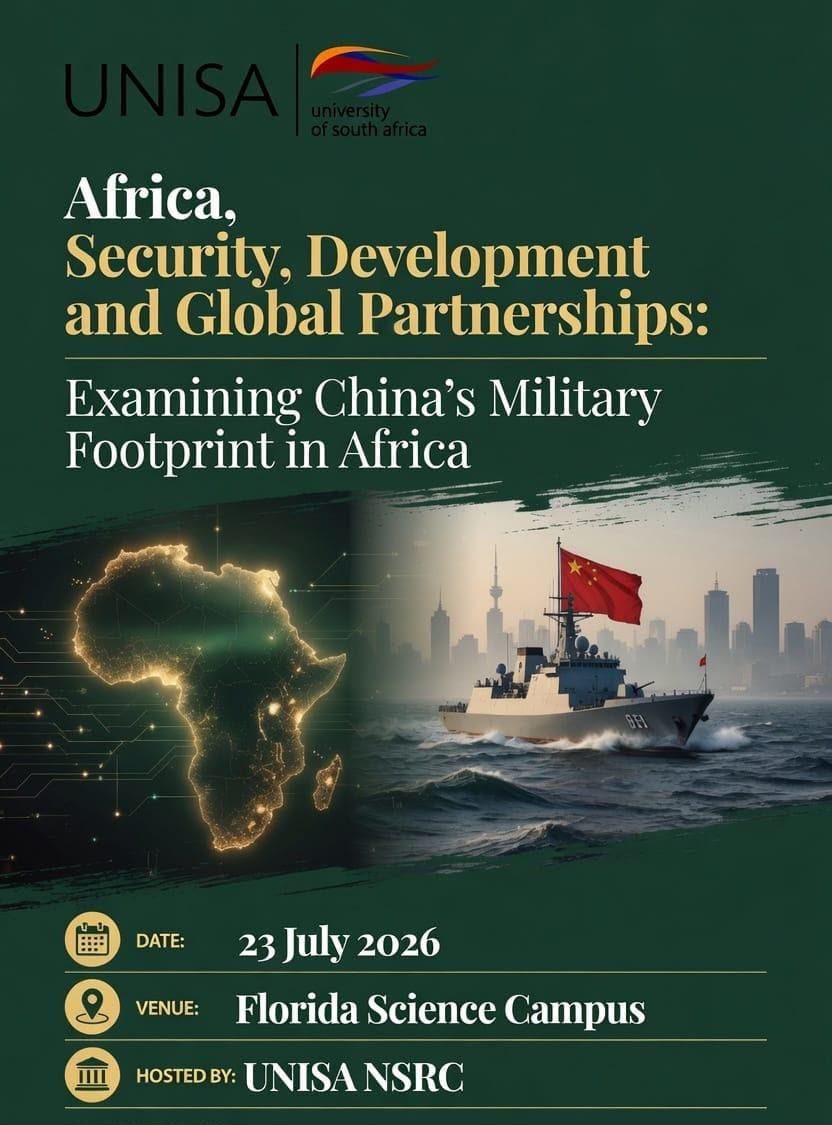
The event brought together law students, scholars, policymakers, and civil society to interrogate one of the most pressing geopolitical questions facing the continent: how Africa navigates security and development amid growing global competition.
“Africa is an Area of Contestation”
Speakers framed Africa not as a passive recipient of global partnerships, but as an active geopolitical space where competing interests converge. The presence of external military actors, infrastructure deals, and resource agreements has placed the continent at the center of 21st-century strategic competition.
Addressing the assembly, a representative of the Centre for Alternative Political & Economic Thought said:
> “Thank you to our hosts, the University of South Africa and the UNISA NSRC, for the warm welcome and for the opportunity to speak at today’s critical program here at the Florida Science Campus.
>
> I am excited to address this assembly representing our organisation, Centre for Alternative Political & Economic Thought in a room filled with brilliant law students, scholars, and the future architects of our constitutional and international jurisprudence.
> As we examine the intersecting dynamics of security, development, and global partnerships under the theme, ‘Africa, Security, Development and Global Partnerships: Examining China’s Military Footprint in Africa’, we are forced to confront a fundamental economic, legal, and moral choice that every sovereign state faces: ‘Do we sacrifice our mineral wealth for the instruments of war, or do we invest public capital in the human capital of our people?’”
Nyerere’s Warning and the Reality of National Interest
The address invoked the legacy of Tanzania’s first President, Julius Nyerere, to frame the debate around sovereignty and priorities.
> “Nyerere warned us that a nation that prioritizes guns over people’s welfare mortgages its future. That warning resonates today as Africa engages with global partners, including China.”
The speaker argued that national interest must be defined not only by defense capabilities, but by investments in education, health, and economic self-reliance. In a continent rich in minerals but burdened by poverty, the choice between security hardware and human capital remains urgent.
The intervention sparked discussion among students and academics on legal frameworks for security agreements, transparency in defense partnerships, and the constitutional obligations of states to prioritize social development.
The Bigger Picture: Security, Development, Partnerships
The UNISA NSRC dialogue positioned China’s military footprint within broader questions of African agency. Topics included:
Security: What are the implications of foreign military bases, training, and arms sales for African sovereignty?
Development: How do security partnerships align with AU Agenda 2063 and the SDGs?
Global Partnerships: Can Africa leverage competition between powers to secure better terms for trade, technology transfer, and infrastructure?
Hosted at the Florida Science Campus, the program underscored UNISA’s role as a hub for policy-relevant research on African security.
Looking Ahead
Participants concluded that Africa must move from being an “area of contestation” to an “area of negotiation” — setting its own terms for engagement. The consensus: partnerships are necessary, but they must be anchored in law, transparency, and a clear development dividend for citizens.
As one student attendee noted: “This is the kind of conversation we need. Not about fear, but about choices.”


Leave a Reply